
This Run Intervals Strength and Conditioning workout is demanding but highly effective for improving overall fitness. It combines short, hard 800 m runs with strength movements to target your cardiovascular system, muscular endurance, and full-body conditioning. Performed with minimal rest between efforts, this session challenges your pacing, transitions and mental grit.
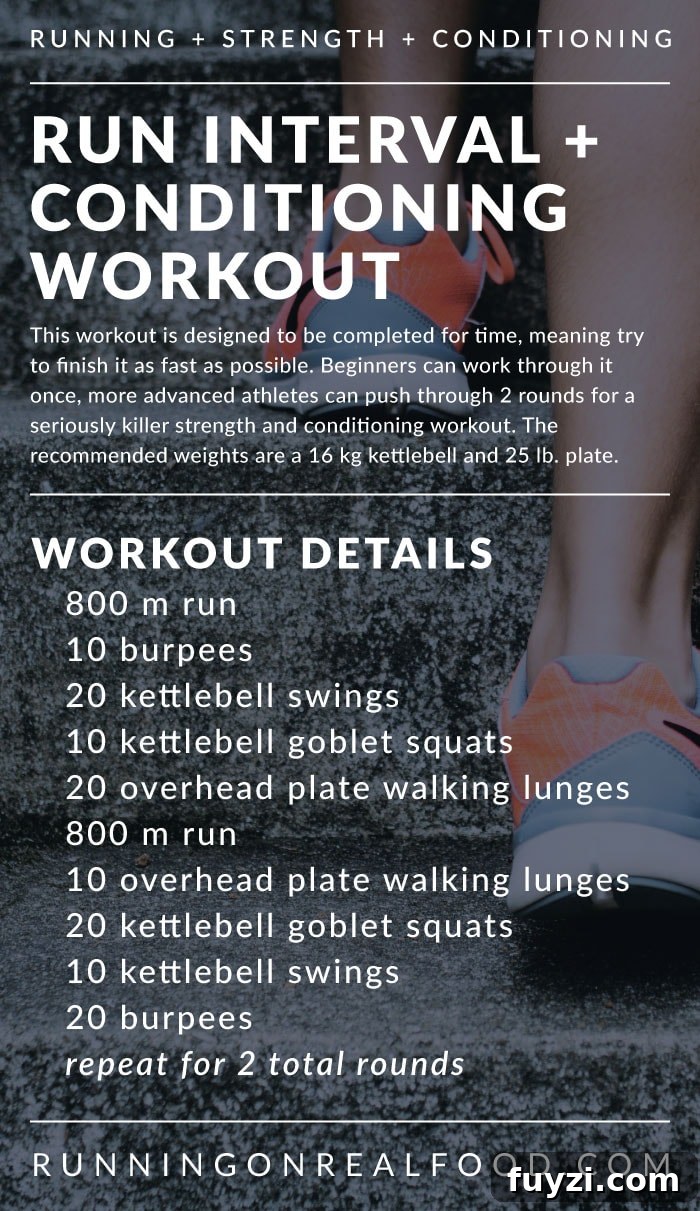
Workout Details
The structure is simple and effective: complete the listed run and strength movements in order, then repeat the sequence for a second round. The intent is to push the 800 m efforts at a hard but sustainable pace and move efficiently through the strength sets. The most challenging moments occur when you finish an intense run and immediately go into weighted strength work.
Equipment needed: a kettlebell for swings and goblet squats, and a weight plate (or an alternative) for overhead walking lunges. Recommended kettlebell weight range is approximately 16–24 kg depending on your strength and experience. For the overhead plate, 25–45 lb is a typical range; choose a weight that challenges you while allowing safe overhead lockout. If holding a plate overhead, keep your arms locked and your core braced for stability.
Perform the runs either outdoors on a measured route or on a treadmill. Pick a pace you can maintain across each 800 m effort; the goal is consistent, hard efforts rather than all-out sprints that leave you unable to sustain the strength work. Keep rest periods brief and deliberate so the session stays intense and time-efficient.
Workout Plan
Repeat for 2 rounds:
- 800 m run
- 10 burpees
- 20 kettlebell swings
- 10 kettlebell goblet squats
- 20 overhead plate walking lunges
- 800 m run
- 10 overhead plate walking lunges
- 20 kettlebell goblet squats
- 10 kettlebell swings
- 20 burpees
Exercise Substitutions
If you don’t have a kettlebell or plate, dumbbells can substitute for all the weighted movements. For space limitations, replace walking lunges with reverse lunges or stationary alternating lunges. You can also use a barbell in the front rack or across the upper back for lunges if that suits your training. If you’re building up to weighted lunges, perform them with bodyweight first and add load progressively as your technique and strength improve.
Other sensible substitutions: swap kettlebell swings for two-handed dumbbell swings, or perform goblet squats with a single heavy dumbbell held at the chest. For burpees, adjust intensity by removing the jump or push-up if necessary. The key is preserving the movement pattern and relative intensity rather than matching exact equipment.
Build Strength + Endurance
This workout is designed to simultaneously develop muscular strength, anaerobic capacity, and aerobic endurance. To get the most from it, minimize rest between sets while maintaining good form. Choose weights that feel challenging but allow you to complete the prescribed reps without breaking technique. If you need to slow the pace to preserve form, do so—quality is always safer and more effective than a rushed, sloppy set.
Scaling options: beginners can complete a single round and reduce weights or rep counts; intermediate and advanced athletes can perform the full two rounds, increase load, or shorten transition rest to raise intensity. Aim for steady pacing on the 800 m efforts—consistent splits tend to yield a stronger overall performance than a very fast first run followed by a sharp drop-off.
Typical session time will vary by fitness level and pacing, but expect roughly 25–40 minutes for two rounds, including short recovery between exercises. Always begin with a dynamic warm-up—5–10 minutes of easy jogging, mobility drills and activation (glute bridges, bodyweight squats, shoulder mobility)—and finish with an easy cool-down and stretching to aid recovery.
Safety notes: prioritize technique on kettlebell swings and goblet squats to protect the lower back and knees. Keep the core braced during overhead work and use a weight that allows a locked-out arm position. If any movement causes pain, substitute or reduce load.
More Workouts to Try
If you enjoy this conditioning session, consider trying these other workouts: 35 Minute Treadmill and Barbell Workout // HIIT Treadmill Hill Workout // Barbell and Burpee 30 Minute EMOM // Legs and Hills Workout // High-Intensity Lower Body Workout