 Have you ever used a written church history in your genealogical research?
Local church histories are often published by a single congregation and can be a rich source for family historians. These booklets or pamphlets typically include background on the surrounding community, membership rolls, minutes and financial records, and photographs of members and church events. They can reveal relationships, occupations, and social networks that are not recorded elsewhere, making them invaluable for building a fuller picture of an ancestor’s life.
Below is a summary of what appears in the paperback history of Baptist Chapel Church, a congregation near Broadway in Lee County, North Carolina. The examples illustrate the kinds of records you may find and how they can support genealogical research.
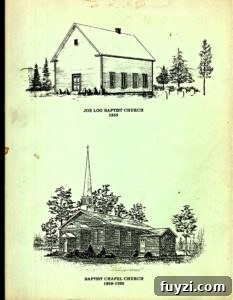
The original location and name of the church
Baptist Chapel Church began life as Joe Log Baptist Church, founded around 1869. The history notes that the origin of the “Joe Log” name is unknown, and it does not specify when the congregation adopted the Baptist Chapel Church name. Early county boundaries placed the church in Moore County; Lee County was not established until 1907, which explains why older records may appear under a different jurisdiction.
Church land donors
The initial property for the church was donated by Jim and Sally Pittman. The churchyard included the Joe Log Cemetery, which the history indicates still exists but whose upkeep was described as “questionable” as of 1986. In 1913, the congregation constructed a new church building on land given by James R. Howard. These land transactions and cemetery notes can help pinpoint places to search for deeds, probate records, and burial information.
Church member rolls
This church history contains partial membership lists for the early congregation. Surnames recorded include Dickens, Kelly, Pittman, Smith, Thomas, and Womack. In addition to general membership rolls, the book lists deacons, officers, teachers, and choir members. These lists can corroborate family connections, provide middle initials or given names, and help place an ancestor within a local social circle.
Church minutes and expense accounts
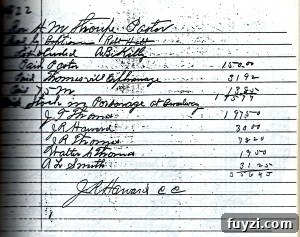
Minutes and financial records are less common in community histories but can be highly informative. These records show who joined or left the church, when ministers were called, and what mission or relief efforts the congregation supported. Financial entries sometimes note payments to individuals, purchases, or specific events—details that enrich a family timeline.
Church histories may also preserve original handwriting and signatures. For example, James Robert (J.R.) Howard served as treasurer for many years and recorded the church’s expenses in his own hand, signing each entry. Such samples of handwriting can be useful for confirming a relative’s identity when comparing signatures in other documents. (J.R. Howard was noted in this history as the uncle of the author’s great-grandfather, Connie Howard.)
Photographs
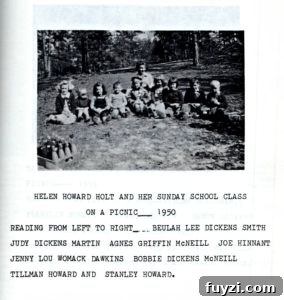
Photographs are among the most exciting discoveries in a church history. Congregational histories often include class photos, group portraits, and images from special events. If your ancestors belonged to the church, carefully examining every photograph may reveal previously unknown images of family members, identify relationships through group placement, or provide clothing and age clues that help date a photograph.
Where to find church histories
To locate church histories, start with family members who may own a copy or know of one. Contact the church directly if it still exists, and check local historical societies, county libraries, and public library vertical files. University special collections and state archives sometimes hold copies of rare local histories as well. Even a single reference in a vertical file or local scrapbook can point you to a fuller printed history.