
I’m excited to share this easy croissant recipe with you. The dough is forgiving, the process is streamlined, and from start to finish it takes roughly three hours. Traditional French croissants are wonderful but require much more time; try them once to compare, but this shortcut delivers beautiful, buttery results in a fraction of the time.

Easy Croissant, at a Glance
✔️ Skill level: Intermediate
✔️ Key skills: Laminating dough, shaping, proofing, egg-washing
✔️ Type: Laminated, yeasted pastry
✔️ Number of ingredients: 7 (plus eggwash)
✔️ Prep time: 30 minutes
✔️ Rise time: About 2 hours total
✔️ Cook time: 30 minutes
✔️ Yield: About 7 large croissants or 15 minis
You Will Love This Recipe If
These croissants are a great fit when you want bakery-style results without the multi-day timeline of traditional croissant methods. You’ll enjoy them if you:
- love buttery, flaky baked goods
- want a crisp outer crust and a tender, layered interior
- want a reliable shortcut that doesn’t sacrifice flavor
Please consider rating and leaving feedback if you try this recipe—reviews help other bakers and help improve future recipes.
Tasting Notes

These croissants are slightly sweet and yeasty, very buttery, crisp and flaky on the outside, and soft and layered within. Full-sized croissants from this recipe are about 5 inches long after baking—nicely browned and not the pale, oversized supermarket style.
How to Make Them
This streamlined method keeps the essential lamination steps but skips time-consuming parts like creating a separate butter block. The dough mixes quickly, then you build layers with a series of folds and short rests. None of the steps are difficult—just a little repetitive.
Ingredients and Substitutions
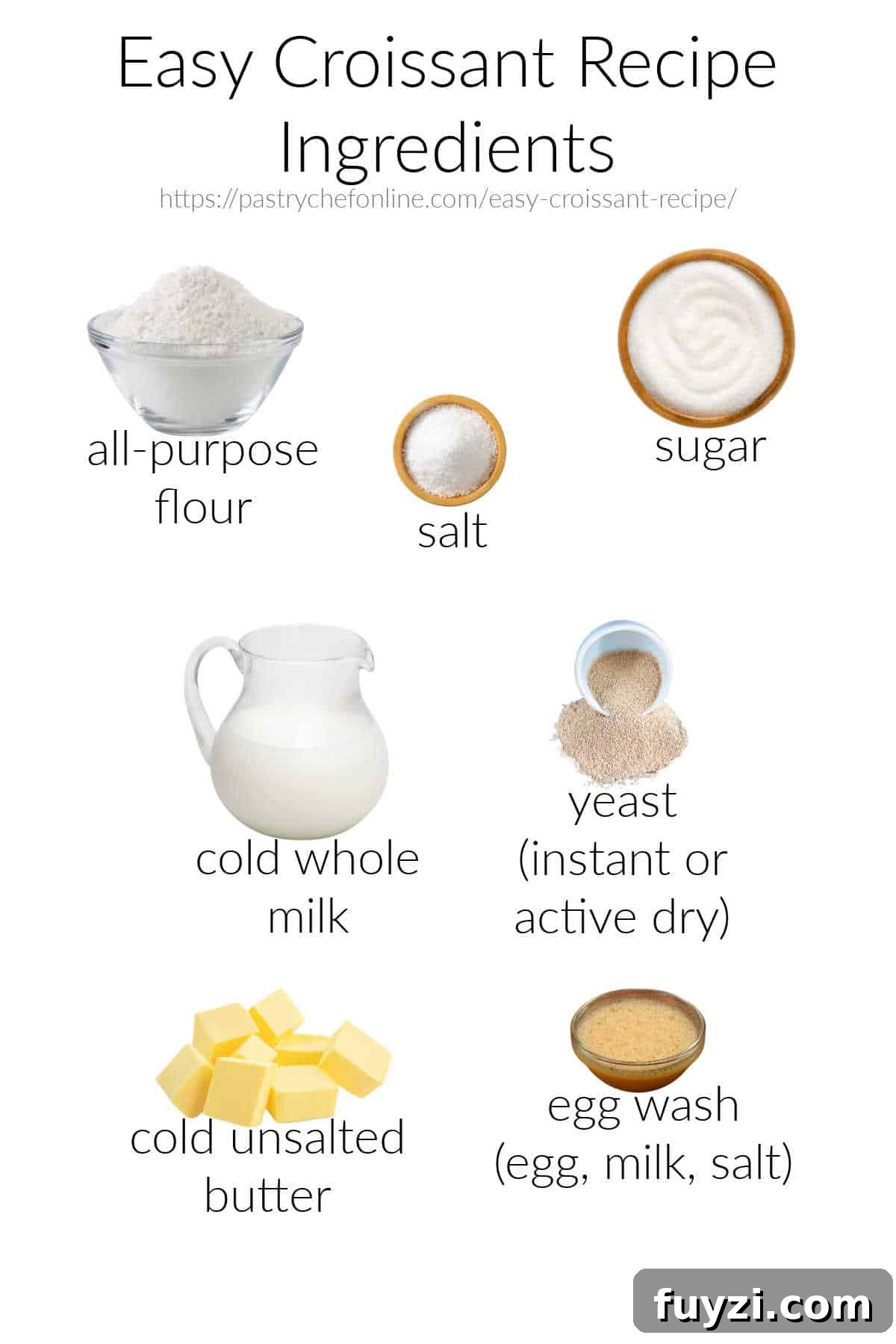
Key ingredients include all-purpose flour, sugar, salt, instant yeast, cold whole milk, and cold unsalted butter. You can substitute up to 50% whole wheat flour for a nuttier loaf, and flavorings like vanilla or citrus zest may be added in small amounts.
Procedure (Overview)
- Whisk dry ingredients including instant yeast. Pour in cold milk and add cold butter cut into chunks.
- Gently combine the dough in the bowl until most flour is incorporated.
- Turn the shaggy dough onto a lightly floured surface, dust a bit more flour if needed, and press the butter chunks slightly with the rolling pin to begin flattening them.
- Roll, fold, and repeat to build layers (see folding schedule below).
Folds and Lamination Schedule
To build the laminated layers quickly, follow this folding sequence. The dough only needs a single short rest during the process:
1 quarter fold (fold in half left to right, then top to bottom)
3 letter folds (roll to a rectangle and fold in thirds, rotating 90° between turns)
1 book fold (fold each end toward the center, then fold like closing a book)
If the butter softens too much, chill the dough for 20–30 minutes. If the dough resists rolling and snaps back, let it rest, covered, for 20 minutes to relax the gluten.
The First Fold
The initial “quarter fold” creates extra layers quickly. Roll the dough to a rough square, fold in half left to right, then fold top to bottom. Roll out again and continue with the letter folds.
Letter Folds
For the next three turns, roll the dough into a rectangle and fold in thirds like a letter, rotating the dough 90 degrees after each turn. Each turn smooths the dough and thins the butter layers.
Final Book Fold
Roll to a long, short rectangle, fold each end toward the center so they nearly meet, then fold the halves together like a book. Rotate 90 degrees and roll to the final thickness—about 3/8″ (9–10 mm).
Trim and Cut
Trim all folded edges so the dough will rise evenly, then cut into triangles for shaping. You can divide the rectangle horizontally to make mini croissants.
Shaping the Croissants
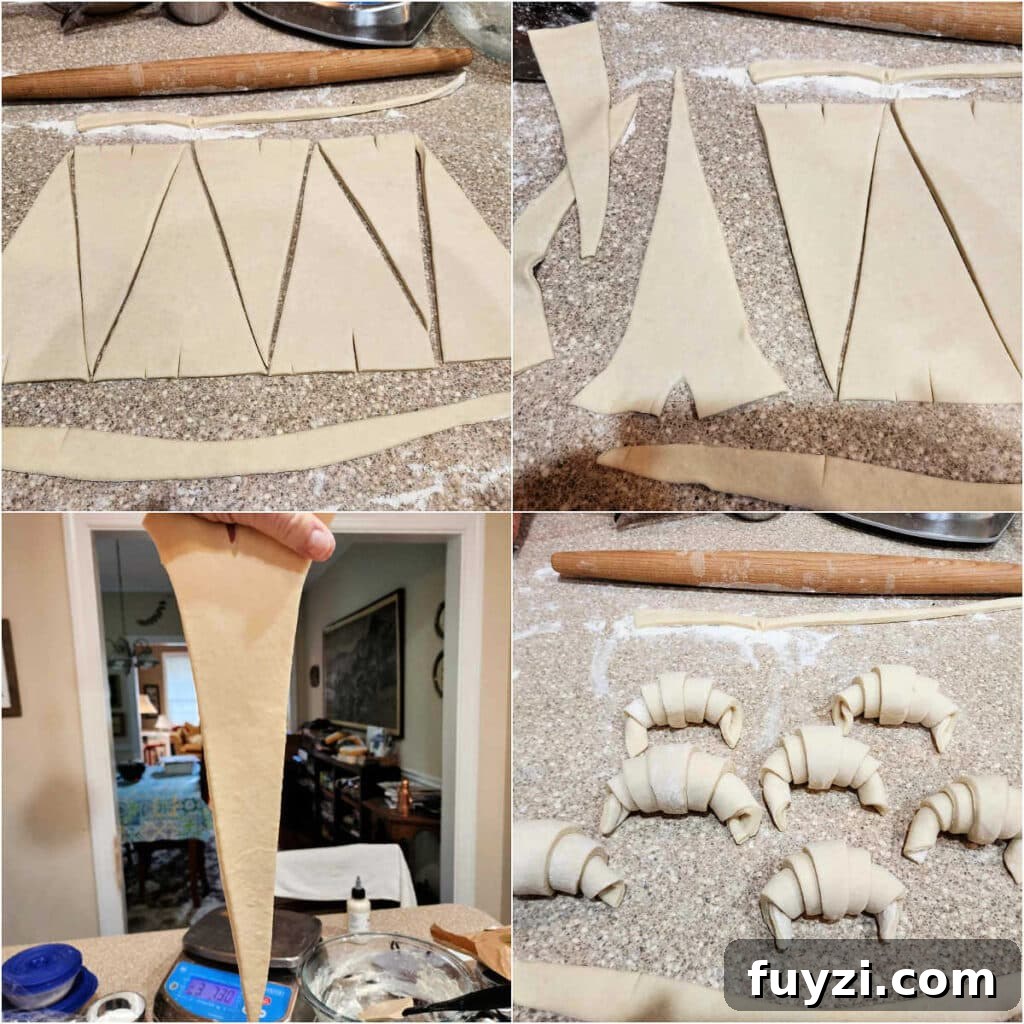
- Cut long triangles roughly 3½–4″ at the base with 8–9″ sides for large croissants.
- Cut a small notch at the triangle base, then gently elongate each triangle by rolling or stretching.
- Pull the notch slightly to start the curve, roll from the base to the tip, tuck the point underneath, and shape into a crescent or leave straight.
Place shaped croissants on a parchment-lined baking sheet with space between for proofing.
Egg Wash, Rise, and Bake
Whisk 1 whole egg with 1–2 teaspoons milk and a pinch of salt. Brush a thin coat on each croissant, then proof at about 78°F (ideal) for 90 minutes until noticeably risen. If your oven is used for proofing, preheat briefly then turn it off so it does not exceed about 78°F.
After proofing, brush another thin coat of egg wash, preheat the oven to 425°F, and bake on the center rack for 10 minutes. Reduce heat to 350°F and bake an additional 15–17 minutes, or until deeply golden brown. Cool 20–30 minutes before serving.
What to Do with the Edges You Cut Off
Trimmed ends make excellent little savory rolls. Roll them up, place in cupcake liners or a tin, spray or brush with fat, sprinkle with salt and pepper, and bake alongside the croissants. Tossing trimmed pieces with cheese, herbs, or cinnamon and sugar also makes great snacks.
Variations
- Whole wheat: replace up to 50% of the flour with whole wheat.
- Medialuna (sweet Argentinian style): double the sugar in the dough.
- Cinnamon croissants: add 1 tablespoon cinnamon to the dry ingredients.
- Pain au chocolat: cut small rectangles and place a baton or a few dark chocolate chips at the base before rolling.
- Ham & cheese or other fillings: use up to ~3 tablespoons of filling to avoid sogginess.
Equipment You May Need
A bench scraper is helpful for folding shaggy dough. A pizza cutter or sharp knife works well to cut triangles. Line your half-sheet pan with parchment for easy cleanup.
Tips and Tricks for Success
- Work quickly but calmly; if butter softens, chill the dough for 20–30 minutes.
- If dough snaps back while rolling, let it rest covered for 20 minutes to relax the gluten.
- Be reasonably precise with your rolls and folds for even layers, but this recipe is forgiving.
Serving Suggestions

Serve croissants with salted butter and jam, or make breakfast sandwiches with eggs and cheese. They also pair beautifully with chicken salad or other savory fillings for a fancy brunch.
Easy Croissant Recipe
Yield: 7 large croissants (about 5″ each) or ~15 mini croissants
Ingredients
- 354 grams all-purpose flour (about 3 cups, measured by whisking, spooning, and sweeping)
- 19 grams granulated sugar (about 4½ teaspoons)
- 1½ teaspoons salt (about 9 grams)
- 255 grams cold whole milk (about 1 cup + 2 Tbsp)
- 2½ teaspoons instant yeast (about 7.75 grams)
- 128 grams cold unsalted butter, cut into 5–6 chunks (about 4.5 oz)
For the egg wash
- 1 egg
- 1–2 teaspoons milk
- Pinch of salt
Instructions
- In a large bowl, whisk together flour, sugar, salt, and instant yeast. If using active dry yeast, proof it in a small amount of the milk first until bubbly, then add to the dry ingredients.
- Pour in the cold milk and add the cold butter chunks to the center. Use a knife blade or spoon handle to mix gently until most flour is incorporated and the dough is shaggy.
- Turn the dough onto a lightly floured surface, sprinkle a bit more flour on top, and press the butter chunks flat with a rolling pin as you roll the dough into a rough 10–12″ square.
- Quarter fold: fold the dough in half left-to-right, then fold top-to-bottom. Rotate 90° and roll to a 10–12″ square again.
- Perform three letter folds: roll to a rectangle, fold into thirds (like a letter), rotate 90°, and repeat twice more. Chill 20–30 minutes if butter becomes too soft.
- Roll the dough into a long rectangle roughly twice as long as it is wide. Fold each end toward the center and fold the halves together (book fold). Rotate and roll to about 3/8″ thickness, roughly 20″ × 12″. Trim edges for an even rectangle.
- Cut into long triangles with bases about 3½–4″. Cut a small 1″ notch at each base, elongate each triangle, pull the notch slightly, and roll up from base to tip. Tuck the tip underneath and shape.
- Place croissants on a parchment-lined half-sheet pan. Whisk egg, milk, and a pinch of salt for the egg wash and brush a thin layer over each croissant. Proof at about 78°F for 90 minutes until noticeably risen.
- Preheat oven to 425°F. Brush croissants with another thin coat of egg wash, bake at 425°F for 10 minutes, then reduce to 350°F and bake 15–17 more minutes until deep golden brown. Cool 20–30 minutes before serving.
Notes & Storage
Storing
Best eaten the day they are made. Store cooled croissants in an airtight container at room temperature for up to 24 hours. For longer storage, freeze in zip-top freezer bags for up to 2 months.
Doubling the batch
You can double this recipe. After making the dough, cut it in half, refrigerate one half, and work the other half so the dough stays manageable.
Nutrition (approximate)
Per large croissant: ~308 kcal; Carbs 38.1 g; Protein 6.2 g; Fat 14.5 g; Saturated fat 8.9 g; Sodium 544 mg; Fiber 1.5 g; Sugar 4.2 g.
Final Notes
I hope you enjoy these croissants. If you make them, tell me how you served them—breakfast, brunch, picnic, or just for the love of baking. Thanks for reading, and happy baking!

Hi, I’m Jennifer. If you like this post, consider subscribing to an occasional newsletter for new recipes and behind-the-scenes updates.